
Enchanted Clearing Adventures: Make a Forest Sound and Recycling Map
What the explorers investigate
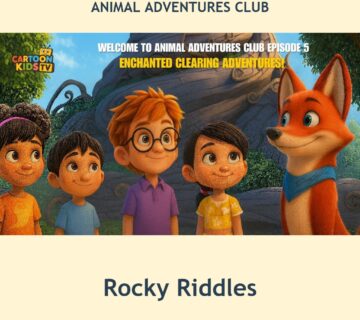
This Animal Adventures Club episode lasts 2 minutes 40 seconds. Maya, Leo, Benji the Fox, and Oliver the Owl visit a hidden forest glade connected by soil microbes, pollinators, fungi, and wildlife. The episode introduces mushroom fairy rings, sound mapping, and the ways a clearing responds to seasons and changing weather.
For a child around three to five, choose one question: What can we hear? Older children can connect those observations to decomposition, food, shelter, and seasonal change. The activities here are home extensions of these themes.
Life above and below the leaves
Many fungi and microbes help break down dead material, making nutrients available again. A mushroom is a visible fruiting structure; much of a fungus can remain hidden as fine threads. A fairy ring can form as a fungus grows outward and produces mushrooms near its edge.
Pollinators and decomposers do different jobs. A butterfly may move pollen between flowers while some fungi break down fallen leaves. Describing the actual connection is more useful than saying every organism helps every other one directly.
Home activity: Draw a two-minute sound map
Materials: paper, pencil or crayons, and a timer. Choose a safe garden seat, park bench, or window with an adult. Stay on an established path and away from water and traffic.
- Draw yourself as a dot in the middle of the paper. Decide which edge represents the space in front of you.
- Listen quietly for two minutes. Keep eyes open or closed according to comfort, while staying seated.
- Place a mark where each sound seems to come from. Use a wavy line for rustling or a little note shape for a call.
- Label sounds you recognize and add a question mark to uncertain ones. Repeat once and compare the two maps.
Hearing a rustle does not prove that an animal made it; wind may move leaves too. Let uncertainty remain on the page. Children can describe loudness, direction, and repetition even when they cannot name the source.
Home activity: Trace a leaf’s recycling story
Materials: four large paper cards, crayons, and a clear tabletop. Use drawings rather than collecting mushrooms, digging soil, or handling decaying material.
- Draw a tree leaf, a fallen leaf, decomposers, and a plant taking nutrients from the soil.
- Arrange the pictures in an order that tells a recycling story. Explain that decomposition usually happens gradually.
- Add pencil lines connecting the cards. Ask where rain, air, and temperature might affect the process.
- Choose one card and explain what is hidden from view. For decomposers, add tiny drawn threads or dots representing organisms too small to see clearly.
This is a model of nutrient recycling, not a claim that one leaf instantly becomes a new plant. Older children can add a separate sunlight symbol: plants obtain energy from light while nutrients circulate through the ecosystem.
Questions worth keeping
- Which sound can we identify, and which remains a mystery?
- Why might a clearing sound different after rain or in another season?
- What useful work could happen where we cannot see it?
Keep exploring through Animal Adventures Club. Our guide to explaining ecosystems to young children can help you connect a single sound or leaf with the wider woodland.
Activity 3: Draw the episode idea
Materials and setup
Use paper, crayons, and one safe household object connected to Enchanted Clearing Adventures. Keep the object on the table and let an adult handle any cutting.
How to play
- Draw the starting situation from the story.
- Circle one detail that helps explain the problem or idea.
- Draw a second version after one change.
- Tell a family member what changed and why.
Parent Prompt: Ask, “What detail would you investigate next?”
Learning Connection: Comparing before and after drawings helps children explain evidence and sequence.
Activity 4: Make a family sorting game
Materials and setup
Prepare six large paper cards with pictures or words related to Enchanted Clearing Adventures. Use broad categories that your child can explain.
How to play
- Place the cards face up and invite a first sort.
- Ask your child to name the rule used.
- Change one card or rule and sort again.
- Compare which rule was easier to explain.
Parent Prompt: Ask, “Could another rule also work?”
Learning Connection: Flexible sorting builds classification and clear communication.
Activity 5: Retell, question, and check
Materials and setup
Use three paper panels labelled Before, During, and After. Keep a question card beside them.
How to play
- Retell one episode moment in the first panel.
- Draw what happened next and add one question.
- Look for an answer in the article or an official source linked below.
- Write or dictate what remains uncertain.
Parent Prompt: Ask, “What evidence supports that answer?”
Learning Connection: Retelling and checking sources connect comprehension with early research habits.
Further Reading and Family Links
Explore the Animal Adventures Club collection and continue with more Cartoon Kids TV learning guides. For background information, visit National Geographic Kids and National Park Service science resources.
Frequently Asked Questions
Are fairy rings made by fairies?
The name comes from folklore. Some fungi grow outward through soil, producing mushrooms in an arc or ring when conditions suit them.
Can we touch or taste mushrooms we find?
Do not taste wild mushrooms. For this activity, observe them from a distance and leave them in place; a familiar appearance does not establish that one is safe.
Does every fungus break down dead leaves?
No. Fungi have different relationships with other organisms. Many are decomposers, while others associate with living plants or obtain nutrients in other ways.
What if our sound map has mostly cars and people?
Record those sounds too. A map describes the place you actually observed; try another time or a nearby quiet window and compare.
Is soil the plant’s food?
Plants make sugars using light, water, and carbon dioxide. Soil supplies water and mineral nutrients, which are needed but are not the same as those sugars.
Does resilience mean a clearing cannot be harmed?
No. An ecosystem may recover from some changes, but repeated disturbance or habitat damage can exceed that ability. Staying on paths and leaving wildlife undisturbed helps.
What can children notice in Enchanted Clearing Adventures?
Invite children to name one detail from the episode before offering an explanation. Their observation can guide a drawing, map, or small home investigation.
How can this episode become a family activity?
Choose one short extension from the guide, keep materials simple, and let children explain what changed or what they still wonder about.
Is the home activity a scene from the cartoon?
No. It is a separate, supervised learning extension inspired by the episode topic. The article identifies when a model simplifies a real process.
Where can parents find reliable follow-up information?
Use the linked official science, education, or cultural institution sources in the Further Reading section and compare information with your child questions.


No comment