Episode 5: Gravity and Planetary Motion: What Kids Learn and Try at Home
A sandwich that floats is funny in a cartoon, yet it also raises a real question: why do objects move differently in space than they do on the floor? Gravity and Planetary Motion gives families a way to ask that question together. The home activities below use paper, balls, and observation to build a model while keeping the model’s limits visible.
Children do not need to memorize equations. They need repeated chances to predict, test, describe, and revise. Keep drops low, use soft objects, and let an adult handle anything that could roll into a walkway. Every activity is a new extension, separate from the episode scenes.
From the episode to a useful model
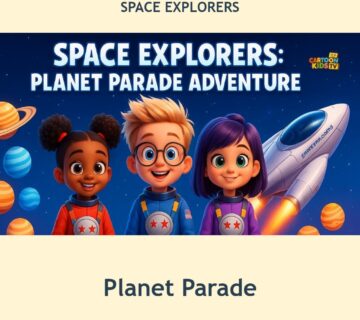
The published Space Explorers description introduces Captain Nova, Astro, and Luna on a zero-gravity mission. It mentions floating sandwiches, a gravity challenge, orbits, a probe launch, and a comparison between Mercury and Neptune. The story’s cosmic dance is a prompt for discussion; the games here do not recreate a launch or claim to show true scale.
Gravity is an attraction between masses. Earth’s gravity pulls objects toward Earth’s center, which is why a dropped toy falls. The Sun’s gravity helps keep planets in orbit, while a planet’s forward motion keeps it from simply falling straight into the Sun. An orbit is a path shaped by this combination of motion and gravity. A paper loop is only a representation.
Mercury travels around the Sun faster than Neptune because it is much closer and has a shorter orbit. That comparison describes orbital periods, not a race children can measure from a single throw. Clarify that astronauts in orbit still experience gravity; apparent weightlessness comes from continuous free fall.
1. Test a gentle gravity drop
Materials and what to notice
Use two same-size soft balls or rolled socks, a ruler, and a clear floor area. An adult chooses a low height and checks for pets, siblings, and fragile objects. Notice that both objects accelerate downward together when released at the same time.
How to play
- Hold the two objects side by side at chest level, then lower them to a safe height.
- Ask which will land first. Release without pushing and watch closely.
- Repeat from a slightly different low height. Record whether the result changed.
- Wrap one object in a loose paper sheet and compare. Air resistance may make the wrapped object fall differently; gravity itself still acts on both.
Parent Prompt: “What did the air change, and what did Earth’s pull keep doing?”
Learning connection: Children separate gravity from air resistance and practice fair comparisons. Do not drop hard objects, throw upward near faces, or turn this into a high platform challenge. A slow-motion phone video is optional and should be used only by an adult.
2. Draw a gravity tug-of-war
Materials and what to notice
Gather paper, crayons, and three large circles labeled Sun, Earth, and Moon. Notice that arrows can represent forces without showing their exact strength or direction in three dimensions.
How to play
- Draw Earth and add an arrow pointing toward its center. Place a toy person on the surface.
- Add the Sun and draw a long arrow from Earth toward it. Explain that the arrow is a simple model of attraction.
- Place the Moon near Earth and add another arrow. Ask what might happen if there were attraction but no sideways motion.
- Draw a curved path around the Sun and label it an orbit. Mark the picture “not to scale.”
Parent Prompt: “How can a path curve when an object is moving forward and being pulled inward?”
Learning connection: The diagram combines force and motion in a form children can revisit. Avoid saying gravity is a string or that an orbit is a perfect circle. Real orbits can be elliptical, and the page cannot show all bodies at their true distances.
3. Make a paper orbit spinner
Materials and what to notice
Use a paper plate or card, a pencil, and a paper dot. Adults make any hole with care. Notice how changing the center point or speed changes the drawn path.
How to play
- Mark a Sun near the center and place the dot on a line from the edge toward it.
- Move the dot around the center with one finger, keeping a steady direction. Trace the path with a crayon.
- Try a wider path and compare how much distance the dot covers each turn.
- Stop and discuss why the spinner is a drawing aid, not a demonstration of a planet’s actual speed or gravity.
Parent Prompt: “What part of our model shows a repeating path, and what part is missing from space?”
Learning connection: Repeated motion supports vocabulary such as path, center, and direction. Younger children can make one circle; older children can trace an oval and explain that orbit periods differ. Keep the tool on a table and avoid spinning pointed objects.
4. Compare planet year cards
Materials and what to notice
Prepare three large cards and a familiar calendar. Write Mercury: about 88 Earth days; Earth: about 365 days; and Neptune: about 165 Earth years. These rounded values help compare orbital periods. Notice that a planet’s year means one orbit around the Sun, so different planets have different year lengths.
How to play
- Find a birthday on the calendar and explain how Earth’s yearly journey relates to our usual calendar year.
- Read the Mercury card together. Count forward roughly three months to imagine a shorter interval, without claiming that three calendar months always equal 88 days.
- Look at Neptune’s card and notice its unit is Earth years, not days. Draw many calendar covers to suggest an interval much longer than a single year.
- Arrange the three cards from shortest to longest orbital period. Ask the child to explain the order using the units as well as the numbers.
Parent Prompt: “If two cards both say a number, why do we also need to read whether they mean days or years?”
Learning connection: Comparing units prevents a common numerical mistake: assuming a smaller-looking number must describe less time. A preschooler can simply sort shortest and longest. An older child can research more precise orbital periods and record the source. The activity compares time, not planet sizes, temperatures, or the distance between the cards.
5. Plan a safe probe mission
Materials and what to notice
Use a folded paper “probe,” tape, a sheet with a drawn planet, and a ruler. Keep launches at table height by sliding the probe rather than throwing it. Notice how changing direction or speed changes where the probe ends.
How to play
- Draw a target planet and a starting line. Predict whether a gentle slide will stop short, reach, or pass the target.
- Slide the probe with the same starting hand position three times. Record the landing points.
- Change one variable, such as the surface or starting distance. Keep the other conditions steady.
- Discuss why a real mission needs many measurements, calculations, and course corrections rather than one dramatic throw.
Parent Prompt: “What did we change, and how can we tell whether that change mattered?”
Learning connection: Children practice controlled variables and see that prediction can be revised. The paper mission is not a rocket design and does not teach launch procedures. Keep tape and small pieces away from toddlers.
Parent tips for explaining invisible forces
Use body language: hold one hand as the inward pull and move the other forward in a curve. Then return to words. If your child says gravity disappears in space, ask what keeps the Moon and satellites in their paths. If a child says astronauts float because there is no gravity, explain free fall with a simple falling elevator analogy only if it feels comfortable; never stage a risky jump.
Watch for the moment a model becomes a claim it cannot support. A finger pushes the paper dot, friction stops a sliding probe, and a hand releases a sock; these are different mechanisms. Ask the child to name the useful feature of each activity and one missing feature. That habit allows a simple demonstration to remain useful without confusing it with the actual system in space.
End with one annotated picture rather than a quiz. A child might draw Earth, an object falling toward it, and a curved satellite path. Let the labels be spoken if writing distracts from the explanation. Return to the same picture after reading a reference and invite one revision.
Connect the episode to safe reading and drawing. The night-sky exploration guide offers another family route into space questions, while the space crafts guide supports making models. Find more episodes in the Space Explorers collection. For authoritative background, see NASA’s gravity overview and planet facts; use them to check a question, not to suggest NASA endorses this activity guide.
Further Reading and Family Links
Explore the Space Explorers collection and continue with more Cartoon Kids TV learning guides. For background information, visit NASA Space Place and NASA’s solar system guide.
Frequently Asked Questions
Does gravity disappear in space?
No. Gravity acts between masses throughout space. Astronauts and spacecraft can feel weightless while they are in continuous free fall around Earth. The episode’s floating sandwich is a playful image, not evidence that gravity has switched off.
Why do planets stay in orbit?
A planet’s forward motion and the Sun’s gravitational pull combine to make a curved path. The planet is continually falling toward the Sun while moving sideways. A paper circle shows the idea without matching real distances or speeds.
Is Mercury always the fastest planet?
Mercury has the shortest orbital period around the Sun, so it completes a trip in less time than the other planets. The calendar activity compares cycle length. It does not mean Mercury moves at one constant speed everywhere on its orbit.
Can we make a real rocket probe at home?
Use a paper probe and table slide for a safe model. Real launch systems require specialist engineering, regulated equipment, and careful testing. Never throw objects toward people, windows, or pets to imitate a launch.
Why did one sock fall differently from another?
Air resistance, shape, release timing, or a push can change the result. Gravity still pulls both objects downward. Repeat with same-size soft objects and describe what you observed before deciding why.
Are orbits perfect circles?
Many are close to elliptical rather than perfectly circular. A circle is an accessible first drawing. Older children can stretch the paper path into an oval and label the model as simplified.
How can preschoolers learn about gravity?
Use a low gentle drop, a rolling ball, and the words down, pull, and path. Let children predict and repeat. Avoid high drops, hard objects, and explanations that require equations.
What does zero gravity mean in the episode?
It is a common phrase for the feeling of weightlessness. It does not mean there is no gravitational attraction. The guide uses the phrase to connect with the story, then introduces free fall in age-appropriate language.
Can a drawing show the solar system to scale?
A normal page cannot show both planet sizes and distances accurately. Label diagrams as models and choose one feature to compare at a time, such as order or orbital period.
Where can we check a space question?
NASA’s science.nasa.gov pages provide authoritative explanations of gravity and planets. Read with an adult, note the date, and compare the source’s wording with the child’s model. Keep the question if the page does not answer it.


No comment